Observe at the sample.
Capture temperature and device observations directly at the individual vial, vacutainer, package or wearable patch.

Thin power, ultra-low-power sensing and BioVerity communications combine to create an item-level digital record that can survive intermittent connectivity and move with the sample.
BioVerity combines thin power, ultra-low-power sensing, local data handling and a proprietary communications and endpoint layer to create an item-level digital record.
The device does not need continuous connectivity to preserve the sample history. It observes at the item, retains the record locally, then forwards it when a compatible communication opportunity is available.
Capture temperature and device observations directly at the individual vial, vacutainer, package or wearable patch.
Non-volatile memory retains timestamped observations while the sample moves through periods with no available communication path.
Stored observations are forwarded over BLE when compatible infrastructure is encountered, allowing the endpoint to reconstruct the item-level record.
Ultra-low-power processing, sensing, BLE communications and local platform functions designed for a thin sample-level sensing architecture.
Thin biofuel-cell power technology supports a flexible alternative to conventional battery-powered trackers and enables the low-power form factor.
Device identity, sensing behaviour, local observation handling, BLE data architecture, transmission behaviour, endpoint integration and reconstruction of the item-level record.
The proposed BioVerity device is an ultra-thin sensing architecture intended to travel with the individual biological or pharmaceutical item. A flexible PCBA combines the ultra-low-power processor, integrated BLE antenna, temperature sensing, non-volatile storage and status functions, with a thin BeFC power layer beneath the electronics.
This architecture separates observation from connectivity. The device can continue sensing and retaining observations locally when a communication path is unavailable, then forward stored information when a compatible BLE communication opportunity is encountered.
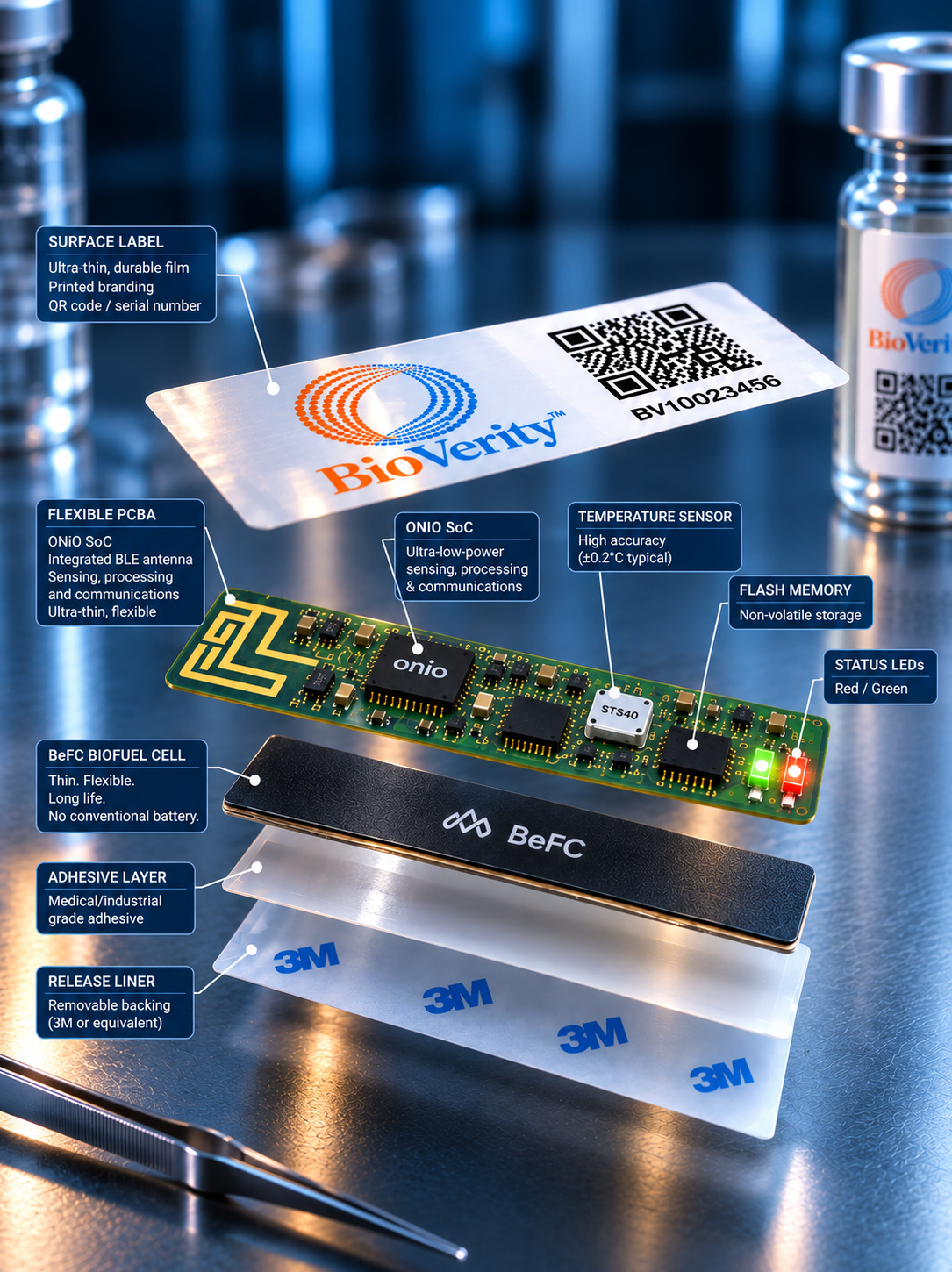
The technology stack is organised around six functions: processing and BLE, condition sensing, local memory, thin power, local status and the BioVerity communications/endpoint layer.
An ONiO ultra-low-power SoC provides processing and Bluetooth Low Energy functions. Integrating the BLE antenna into the flexible PCBA avoids a separate rigid antenna module and supports the thin form factor.
A high-accuracy temperature sensing element allows condition observations to be associated with the individual vial, vacutainer, package or wearable patch, rather than only the outer shipping container.
Non-volatile storage retains sensing observations between communication opportunities. Continuous network connectivity is therefore not required simply to preserve the sample history.
A thin, flexible BeFC biofuel-cell power layer supports the ultra-low-power electronics without the rigid coin-cell architecture used by many conventional trackers.
Low-power red and green status indicators provide direct device feedback for activation and status functions without requiring a display or bulky user interface.
BioVerity coordinates device identity, sensing behaviour, local record handling, BLE transmission, endpoint integration and record reconstruction. The architecture is intended to provide useful sample history without GPS/GNSS, a SIM or cellular modem on every label.
The label architecture is designed without a GPS/GNSS receiver, SIM or cellular modem on the label and without dependence on a dedicated BioVerity gateway network. Connectivity can be intermittent while the sensing and local-storage architecture preserves observations between communication opportunities.
Connectivity can be intermittent. The sample record doesn’t have to be.
No GPS/GNSS receiver on the label. No SIM. No cellular modem on the label. No dedicated BioVerity gateway network required.